Studies: The Perspectives of Art
I'm back, and with a new topic of study for the day. I am going to go over One and Two Point Perspective in Art.
Before I talk about Perspective though, let me drop an important definition regarding this tool.
Horizon:
We drop the word in conversations a lot, so it shouldn't be too hard to grasp it. A horizon is basically the invisible line which represents your eye level, and how you are viewing a scene. It also represents how you shall see certain objects. Take the ocean below.

In a literal sense, the horizon is that point in the middle where the ocean and sky just seem to disappear from our sight, similar to a wall. But the difference between this photo and a wall is the depth given by the horizon line.
Case in point, you know that the ocean seems to be coming closer to us as you reach the bottom of the picture? So imagine you were floating over the ocean and you happen to be seeing this same exact scene; where would the ocean eventually go? Under you, and the sky would be above.
You see, objects that are below the horizon line are always objects which you will see the top of as they come closer in and objects that are above the horizon line will be objects you can always see the bottom of.
And the way this depth works changes drastically depending on where you intend the horizon to be.

If you were to look down, you would begin to see more of the top parts of the objects that are below you.
And the same applies for up.

Now keep in mind, these images are just a basic and rough idea of what would happen. I encourage you to simply go outside and take a look for yourself. Stand somewhere high up and look off into the distance to where you can see a horizon line and begin to look up and down. You'll notice some amazing things when you pay attention.
And now we have one last definition to explain: Vanishing Point
A vanishing point is essentially the one point in a perspective where everything will seem to be converging onto one area way off into the distance.
Take this road for example.

It doesn't take a genius to notice that the white lines at the side of the road look as if they are going to meet up in the middle of the road, the further and further you look, and the road also seems to be shrinking towards the middle of your field of vision.
This is a vanishing point. All objects on this road quickly converge as they move farther and farther away, until they vanish on this one point.
However, a vanishing point doesn't have to be in the distance to be one. It can also be up close.
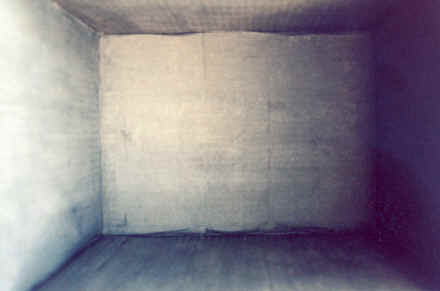
What matters is that everything is heading in the direction of the Vanishing point, therefore, it is one.
So now you hopefully understand the nature of the horizon line and vanishing points a bit better, now we can move on to talking about the perspectives that you are capable of with a horizon line and vanishing points.
------------
I've learned of about 7 types of perspectives so far, but for now, I believe I'll only talk about five of them for sanity's sake.
One Point- Perspective
Two Point Perspective
Three Point Perspective
Four Point Perspective
Zero Point Perspective
One point Perspective is easily the most common of the bunch. It is essentially when there shall be one vanishing point in the entire picture that everything shall converge on. Those pictures I had shown of the wall and the road were both essentially that.
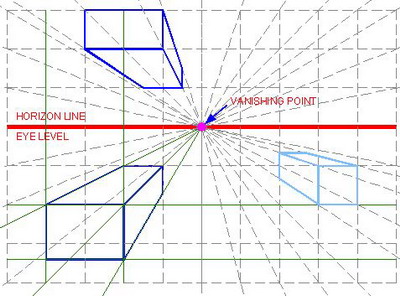
But don't be so one minded; after all, there are plenty of other ways to capture a one point perspective, as long as your vanishing point remains on the horizon, it can be anywhere in the picture. (And since the horizon doesn't have to be in a set position...)


And here is essentially how you would grid something in a one point perspective.

Just remember, everything must converge onto the one vanishing point.
Continued in Part Two For Space Sakes.
In a literal sense, the horizon is that point in the middle where the ocean and sky just seem to disappear from our sight, similar to a wall. But the difference between this photo and a wall is the depth given by the horizon line.
Case in point, you know that the ocean seems to be coming closer to us as you reach the bottom of the picture? So imagine you were floating over the ocean and you happen to be seeing this same exact scene; where would the ocean eventually go? Under you, and the sky would be above.
You see, objects that are below the horizon line are always objects which you will see the top of as they come closer in and objects that are above the horizon line will be objects you can always see the bottom of.
And the way this depth works changes drastically depending on where you intend the horizon to be.
If you were to look down, you would begin to see more of the top parts of the objects that are below you.
And the same applies for up.
Now keep in mind, these images are just a basic and rough idea of what would happen. I encourage you to simply go outside and take a look for yourself. Stand somewhere high up and look off into the distance to where you can see a horizon line and begin to look up and down. You'll notice some amazing things when you pay attention.
And now we have one last definition to explain: Vanishing Point
A vanishing point is essentially the one point in a perspective where everything will seem to be converging onto one area way off into the distance.
Take this road for example.
It doesn't take a genius to notice that the white lines at the side of the road look as if they are going to meet up in the middle of the road, the further and further you look, and the road also seems to be shrinking towards the middle of your field of vision.
This is a vanishing point. All objects on this road quickly converge as they move farther and farther away, until they vanish on this one point.
However, a vanishing point doesn't have to be in the distance to be one. It can also be up close.
What matters is that everything is heading in the direction of the Vanishing point, therefore, it is one.
So now you hopefully understand the nature of the horizon line and vanishing points a bit better, now we can move on to talking about the perspectives that you are capable of with a horizon line and vanishing points.
------------
I've learned of about 7 types of perspectives so far, but for now, I believe I'll only talk about five of them for sanity's sake.
One Point- Perspective
Two Point Perspective
Three Point Perspective
Four Point Perspective
Zero Point Perspective
One point Perspective is easily the most common of the bunch. It is essentially when there shall be one vanishing point in the entire picture that everything shall converge on. Those pictures I had shown of the wall and the road were both essentially that.
But don't be so one minded; after all, there are plenty of other ways to capture a one point perspective, as long as your vanishing point remains on the horizon, it can be anywhere in the picture. (And since the horizon doesn't have to be in a set position...)
And here is essentially how you would grid something in a one point perspective.
Just remember, everything must converge onto the one vanishing point.
Continued in Part Two For Space Sakes.

No comments:
Post a Comment